
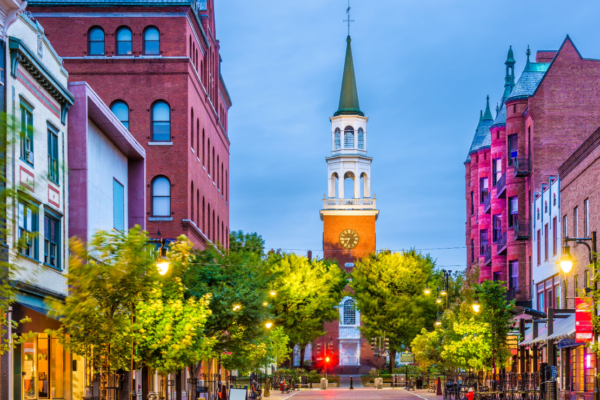
We all want our downtowns to be safe and supportive spaces for our communities as a whole. We all want our neighbors to feel safe in our public spaces, while offering compassionate solutions for those who are struggling and have nowhere to go.
As towns and cities across Vermont, including Burlington, grapple with big questions about how to foster community safety for all, it’s not uncommon to hear some blame the people who are most impacted by policy failures for the challenges we face. Instead of scapegoating the most vulnerable people in our communities, we need to first recognize the root causes of the challenges we face—and then make robust investments in evidence-based strategies to solve those policy failures.
“Burlington Forward”
The ACLU of Vermont sees clear common ground across the diverse range of voices expressing concern for safety and dignity of everyone who calls our state home. Burlington City Councilors recently released their “Burlington Forward” proposal—and although we understand where municipal leaders are coming from, we have significant concerns about many of the strategies they have chosen to prioritize.
Addressing root causes of unsheltered homelessness
Importantly, our collective strategy must be clear about the root causes of the problems we are facing as a state if we hope to solve them. Over the last few years, decisions by state leaders have forced us to watch with growing alarm as thousands of Vermonters- including over 1,000 children- have become unsheltered and pushed onto the streets, resulting in the 4th highest rate of homelessness in the country. A lack of housing and unmanageable rents force more and more families into homelessness each year and make it ever harder for those already without shelter to find a place to live. We have all witnessed this reality unfold across our communities. Put simply: People are struggling.
Amidst this reality, we have seen significant cuts to our emergency shelter system leaving hundreds more individuals unsheltered. This past year the legislature, spurred on by the Scott administration, moved to reduce the capacity of our emergency shelter system by nearly one-third. It is no surprise that, consequently, our towns and cities are reaching a breaking point in the face of a worsening unsheltered homelessness crisis. The ACLU of Vermont has loudly advocated against these cuts to essential housing programs, and we invite the City of Burlington and all municipalities impacted by these short-sighted decisions to join us in advocating for systems that keep people sheltered and provide meaningful pathways to permanent housing.
While the Burlington proposed resolution on homelessness offers areas of alignment in terms of its broad goal for safe public spaces in our community, it proposes policies of significant concern. For example:
- Expanding law enforcement surveillance
- Deputizing civilian teams to conduct law enforcement,
- Holding private property owners criminally or civilly liable for unlawful for activities occurring on their premises
- Vowing to send our most vulnerable neighbors to other communities
- Undermining implementation of data-driven strategies that would reduce harm and save lives
- Sweeping up the shelter and belongings of people with literally nowhere to go
We are deeply concerned that many of the policies at the heart of this proposal amplify rhetoric we see at a state and national level that depicts our struggling neighbors as somehow disposable and separate from our communities. Vermonters expect better.
Criminalization is counterproductive, inhumane, and wildly expensive
Criminalizing people experiencing homelessness or punishing them for existing in public spaces, including doing the life-sustaining things they need to do to survive in Vermont’s cold winters, doesn’t do anything to reduce homelessness. Forcing more people experiencing hardship into our criminal legal system will not revitalize our downtowns, solve our homelessness crisis, or make our communities safer. Charging people who are homeless with criminal offenses makes it harder for them to get jobs and, consequently, housing.
Our prisons are already overcrowded, and it costs roughly $95,000 per year to incarcerate someone in Vermont. There are far more effective and fiscally responsible ways to address community safety.
A path forward
Without addressing root causes of housing access on an individual level, systemic challenges of our homelessness crisis will continue to worsen. Ensuring our communities have their basic needs met is public safety.
That includes badly needed investments and policy reforms in affordable housing, mental health care, addiction treatment, harm reduction programming, youth programs and education – all the things that we have drastically underfunded for decades.
The people of Vermont have consistently rejected the costly and ineffective approaches to public safety that have failed us for so long. They want better strategies that rely on proven, evidence-based policies and investments to prevent crime in the first place. These include stronger investments in affordable housing, education, mental health and substance use services, and community-based alternatives to incarceration.
We recognize that many cities and towns are in an impossible position, and that responding to the unique needs of unsheltered Vermonters during a historic housing shortage with limited resources is exceptionally challenging. Community members are understandably frustrated with the consequences of the State’s policy and moral failures. But municipalities cannot—and should not seek to—respond by pushing down and dehumanizing people experiencing homelessness. They should instead direct that energy toward persuading Vermont’s leaders to systematically and humanely resolve this crisis of their own making. Please join us in this charge.