
The ACLU and our partners are proud to launch “ICE Out”: a statewide campaign to educate, empower, and equip residents, local businesses, property owners, and public institutions to assert their rights and defend our communities against the violence of federal immigration officials.
Placing one of our downloadable ICE OUT signs in your home or place of work can help send the message immigrants are welcome here – and lawless federal agents are not.
Across Vermont, ICE and Border Patrol continue to target our neighbors for arrest and deportation, tearing families apart and terrorizing our local communities. Regardless of who or where you are, you have rights, and new state protections give us even more tools to push back against the federal government's lawlessness and abuse.
Under Vermont’s Act 150, ICE and Border Patrol are strictly prohibited from making civil arrests in sensitive locations like schools, hospitals, and government buildings. The ACLU of Vermont’s ICE Out campaign translates these new legal protections into action, empowering homeowners, renters, business owners, and public employees to understand the legal limits on federal agencies and defend our private and public spaces.
New and existing legal protections
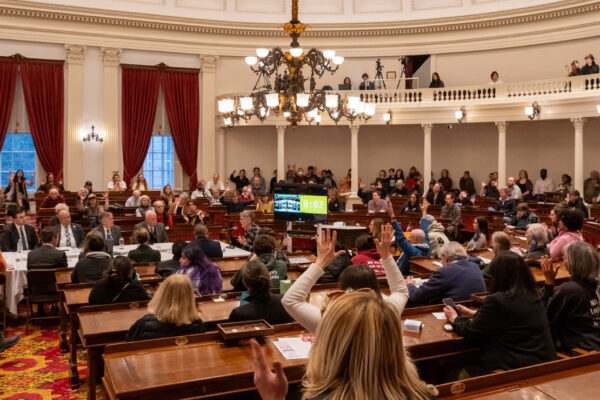
Following the botched March 11 ICE raid in South Burlington, the ACLU of Vermont and our coalition partners took action, working alongside community members to pass some of the most significant law enforcement accountability measures in the country. These bills created vital new shields for our communities, on top of our existing constitutional rights to be free from unreasonable search and seizure:
For all Vermonters, understanding how the law protects you is the first step in keeping our communities safe.
If you are a homeowner, renter, or private business owner, your constitutional rights go beyond Act 150. You hold significant authority over who steps onto your property.

Know Your Rights: Steps to take during an ICE enforcement action
- Ask for identification and a warrant: Request to see the officers' credentials and a judicial warrant signed by a judge. Without a valid judicial warrant, ICE should not make an arrest in that location.
- Exercise your right to remain silent: You always have the right to say nothing. Never lie to law enforcement, but remember that remaining silent is fully protected by law.
- Alert support contacts: Call your designated point person or a lawyer immediately to report ICE’s presence. You are not required to help ICE locate their target person(s).
- Record from a safe distance
- Keep your distance: You have the right to record in public spaces but do so at a safe distance and comply with officer commands. Film yourself following instructions (such as taking a step back) to document that you are not interfering.
- Focus on the officers: Aim your camera at the officers, not the face of the person being arrested.
- Protect your device: Officers cannot seize your phone or view your footage without a judicial warrant.
- Avoid physical interference: Never touch officers or physically get in their way.
- Document key details: If you cannot film, write down the date, time, exact location, officer details/badge numbers, vehicle info, witnesses, and any damage or injuries as soon as possible.
Learn more about your rights at acluvt.org/kyrim
Steps for ICE preparedness
Practice these steps with your team just like a fire drill.
- Post clear signage: Download printable “ICE Out” window signs for public, private business, and residence entrances to send an unmistakable message at your door. Mark internal spaces (employee breakrooms, back offices) clearly as private.
- Download and display "ICE Out" signage: Download printable window signs for public facilities, private businesses, and residences to send an unmistakable message at your door.
- Show your support online: Take a photo of your displayed window sign and share it on tag us on social media @acluvermont to encourage others to join the movement.
- Designate a point person: Contact the point person or lawyer if ICE arrives or requests information.
- Train and practice: Educate staff to request identification, ask for a judicial warrant or court order, assert their right to remain silent, and notify the designated point person.
Who to contact to report ICE action?
If you witness an active ICE enforcement (e.g., roadside stop, home or workplace entry, arrest), Migrant Justice has trained community defenders who can coordinate real-time responses and documentation consistent with national best practices. Learn more at migrantjustice.net/rapid-response.
To report violations in sensitive locations from ICE enforcement, please contact the Office of the Vermont Attorney General.
If you have secondhand or retrospective information, photos, or testimony about ICE activity that is not currently unfolding, you can contact the Vermont Asylum Assistance Project (VAAP) at vaapvt.org/icetracker. This keeps the Migrant Justice Rapid Response line free and allows organizers to verify information, identify patterns, and prevent rumors from spreading through social media or text chains later.
Vermonters have spoken
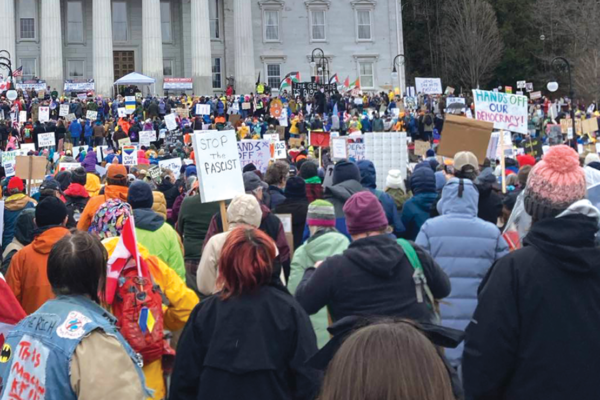
Vermont has long had policies to protect residents and restrict local authorities from getting entangled in ICE activity. But as ICE continues to target community members across the state, more Vermonters and local leaders are speaking out. Burlington Mayor Emma Mulvaney-Stanek signed an executive order on Act 150, announcing administrative support for people working in sensitive locations and reiterating guidance for the Burlington Police Department in the event of ICE activity in Burlington. Brattleboro’s police chief recently confirmed officers would not get involved with ICE, and asked residents to call Brattleboro police if they spot ICE activity in the area.
In a recent poll commissioned by the ACLU of Vermont, a majority of Vermont voters across political affiliations—including 82% of Democrats—supported the elimination of ICE. Furthermore, over 60% of voters support providing legal representation for immigrants facing deportation hearings, a top legislative priority entering 2027.
Ultimately, Vermonters are sending an unmistakable message: protect our neighbors and keep ICE out of our state.